01The Logic of the Gate
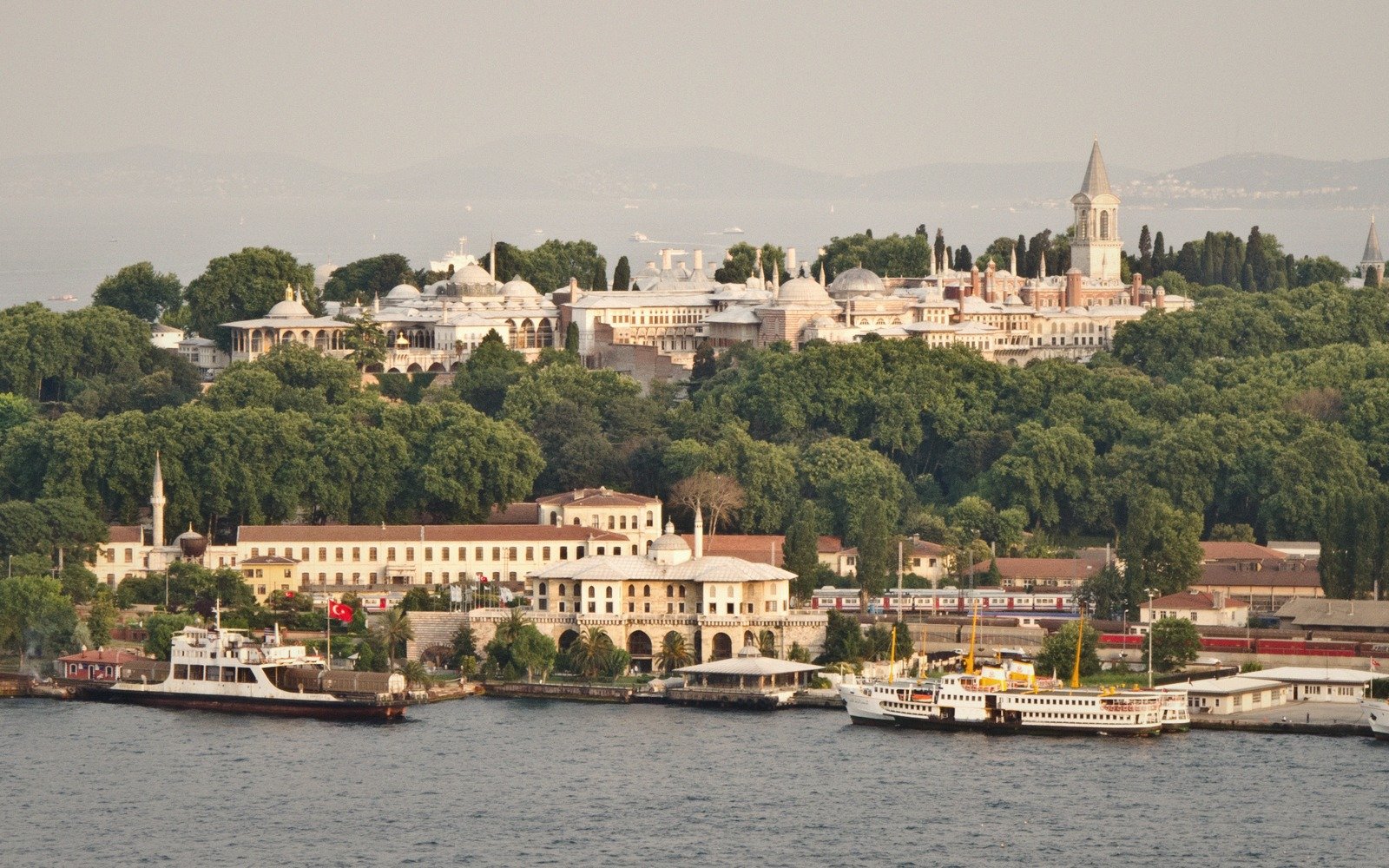
Most palace architecture announces itself from the outside — a façade, a grand stair, a symmetry designed to impress before you have even entered. Topkapı does the opposite. Approach it from the city and you find walls. Pass through the Imperial Gate, Bâb-ı Hümâyun, and you arrive not at a palace but at a courtyard — open, green, lightly planted, unhurried. There is a second gate ahead. You are inside, but you have not yet arrived anywhere in particular.
This is deliberate, and it is the whole design logic. Topkapı, built from the 1460s onward under Mehmed II on the first hill of Istanbul overlooking the Bosphorus and the Golden Horn, is not a single building with rooms. It is a sequence of enclosed outdoor spaces, each leading to the next through a guarded gate, each one smaller, quieter and more restricted than the last. Power here was not displayed in a hall. It was expressed in the right to pass through another door.
The palace accumulated for roughly four centuries, through the reigns of more than twenty sultans, and the result is not a coherent architectural statement but an aggregation — pavilions, kitchens, armories, libraries and treasuries arranged around these courtyards like deposits around a core. What holds it together is not style but sequence.
02Court by Court
The First Courtyard, the one entered through Bâb-ı Hümâyun, was essentially public. Firewood suppliers, water carriers, traders and petitioners all moved through it. Hagia Sophia stands just outside the Imperial Gate; the courtyard sits in its gravitational field, part of the same imperial topography that the Byzantines had established and the Ottomans redrew.
The Second Courtyard, reached through the Gate of Salutation (Bâb-üs Selâm), was where business was conducted — where the Imperial Council, the Divan-ı Hümâyun, met to govern the empire. To the right stand the palace kitchens, an enormous range of chimneys and domes that once fed several thousand people daily and now house the porcelain collection. The kitchens' scale alone tells you what kind of institution this was: not a royal household but a government. Audiences with the sultan were held in the Arz Odası, the Chamber of Petitions, at the courtyard's far end — a small, finely tiled pavilion that made supplicants feel the asymmetry before a word was spoken.
The Third Courtyard, through the Gate of Felicity (Bâb-üs Saade), was imperial territory proper. Almost no one crossed this threshold — only pages trained in the palace school, high officials summoned specifically, and the sultan himself. The courtyard contains the Enderun, the inner palace school that produced grand viziers and governors for generations, and the Library of Ahmed III, built in the early eighteenth century and sitting in the courtyard's centre like a calligraphic object in stone. The Treasury here holds the Topkapı Dagger and the Spoonmaker's Diamond, objects so often photographed that it takes a moment to register how strange and layered a collection has accumulated here: Iznik ceramics, manuscript Qurans, the relics of the prophet and early caliphs that Selim I brought from Cairo in the early sixteenth century.
The Fourth Courtyard — gardens really, a series of terraced spaces with kiosks — is the loosest, most un-palace-like part of the complex: the Baghdad Pavilion, the Circumcision Room, a pool terrace with a view across the water that no formal room could replicate. The architecture here relaxes into something almost domestic.
The First Courtyard, the one entered through Bâb-ı Hümâyun, was essentially public.