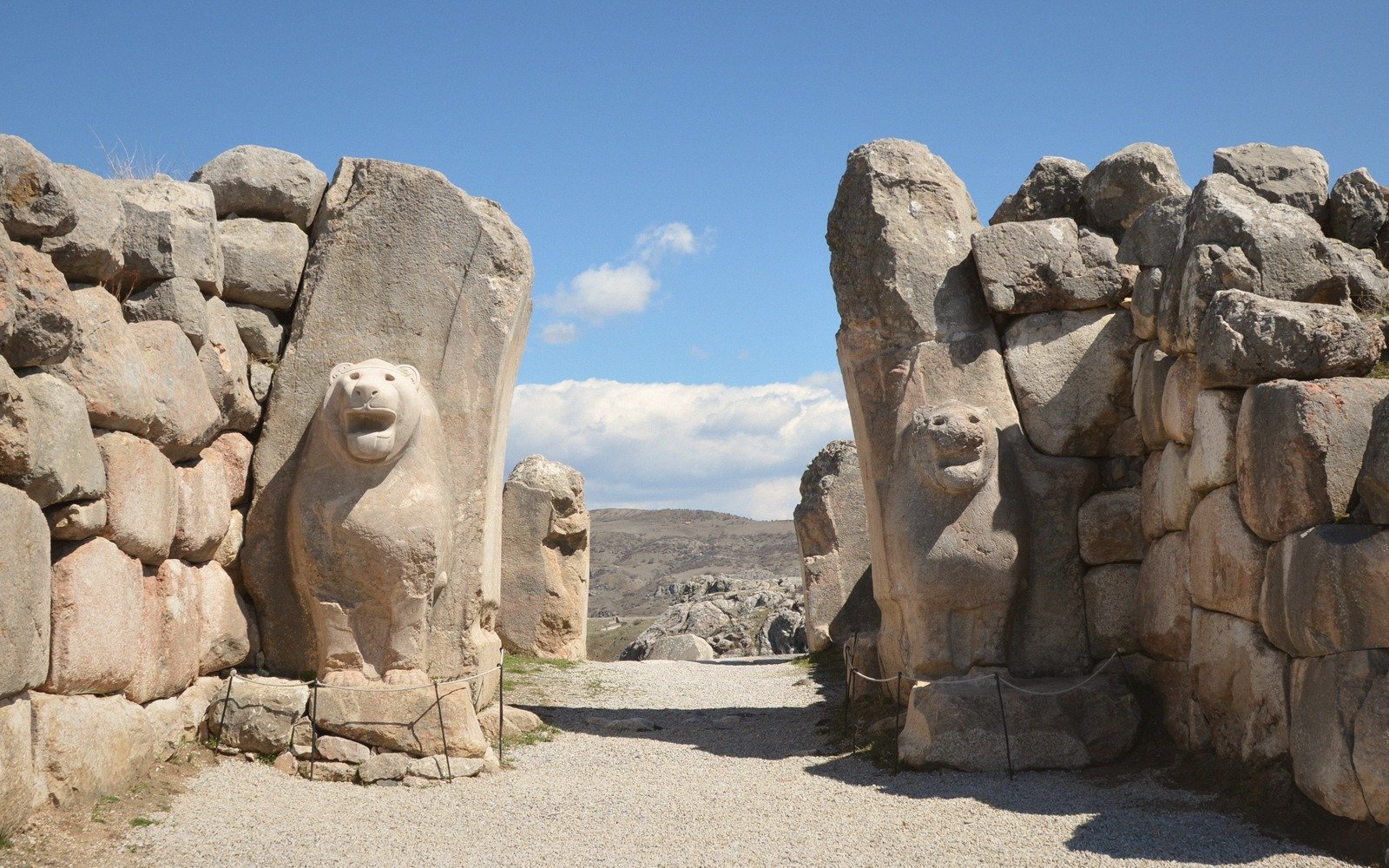
A Power That Spoke on Equal Terms
For several centuries in the second millennium BCE, the Hittites held one of the ancient world's great empires — one that corresponded with Egyptian pharaohs not as a vassal but as an equal. Their king addressed Ramesses II as "brother." The treaty they concluded after the Battle of Kadesh, around 1259 BCE, is sometimes cited as the earliest surviving peace agreement, and both the Hittite and Egyptian versions of it have been found.
Their capital, Hattusa, sat at roughly 1,000 metres in the rocky highlands of central Anatolia, near what is now the village of Boğazkale in Çorum province. The site's scale still impresses: massive defensive walls, the remains of temples, and the famous Lion Gate — a double-arched entry whose threshold lions, carved in high relief, once faced down everything approaching the city. A second gate, the Sphinx Gate, preserves sphinxes that guarded the southern approach. These are not decorative flourishes but statements of power in stone.
What makes the Hittites unusually legible among ancient Anatolian cultures is their archives. Thousands of clay tablets, written in cuneiform, survived in the ruins. They document treaties, legal codes, religious rituals and diplomatic correspondence in the Hittite language — an Indo-European tongue, which placed it in an unexpected relationship to Greek, Latin and Sanskrit. The tablets are now spread across the Museum of Anatolian Civilizations in Ankara and the Istanbul Archaeological Museums.
Then, around 1200 BCE, the empire collapsed — quickly, and as part of a broader catastrophe that brought down several eastern Mediterranean civilizations at once. The causes remain debated: drought, internal fragmentation, the movements of peoples across the Aegean. Hattusa was burned and abandoned. Successor states calling themselves Hittite persisted in southeastern Anatolia and northern Syria for a few more centuries, but the central empire was gone.
So thoroughly gone, in fact, that it disappeared from historical memory entirely. Nineteenth-century scholars piecing together ancient Near Eastern history had almost no idea the Hittites had existed until decipherment of the tablets and excavation of Hattusa confirmed what a few strange Egyptian records had hinted at all along.
So thoroughly gone, in fact, that it disappeared from historical memory entirely.