The repeat is the design
A single tile, lifted from an Ottoman wall, is almost never the point. What you are looking at when you see one in isolation — in a museum vitrine, or in a salvage dealer's stock — is a fragment of a sentence, a word with no grammar around it. The pattern lives in the repeat, and the repeat only becomes visible once the field is laid.
The most demanding of all Islamic tile geometries is the star-and-cross, and it is worth understanding from the ground up, because once you see how it works you cannot unsee it. The grid it rests on is not a square grid. It is a grid of interlocking polygons — specifically, eight-pointed stars and small cross-shaped connectors — and neither shape tiles the plane on its own. They only close up and leave no gaps when they are placed together. This mutual dependency is the whole logic of the system: neither element is background, neither is foreground. Take away one and the other becomes impossible.
Setting out such a field begins before a single tile is placed. The craftsman — the çini maker working in a tradition whose high point runs from roughly the mid-fifteenth to the late-seventeenth century — first establishes the repeat unit on paper or on a plaster cartoon. The repeat unit for a star-and-cross field is not one star. It is the smallest cell from which the entire field can be generated by translation alone, with no rotation required. In practice this means a rectangle containing parts of several stars and several crosses, each cropped at the repeat boundary so that when the unit is slid — not flipped, not turned — and placed beside itself, the partial shapes complete each other exactly. The seams disappear into the geometry.
This is why the borders of a tiled panel demand particular skill. A field can, in principle, go on indefinitely — the geometry has no natural edge. Stopping it requires a conscious decision about where to cut, and the cut must be handled so that the eye reads it as a frame rather than an interruption. A wide border in a contrasting palette, often a running arabesque or a knotted vine, signals that the field has ended intentionally. Without that frame, the truncated star-points at the panel edge would read as damage. With it, they read as enclosure.
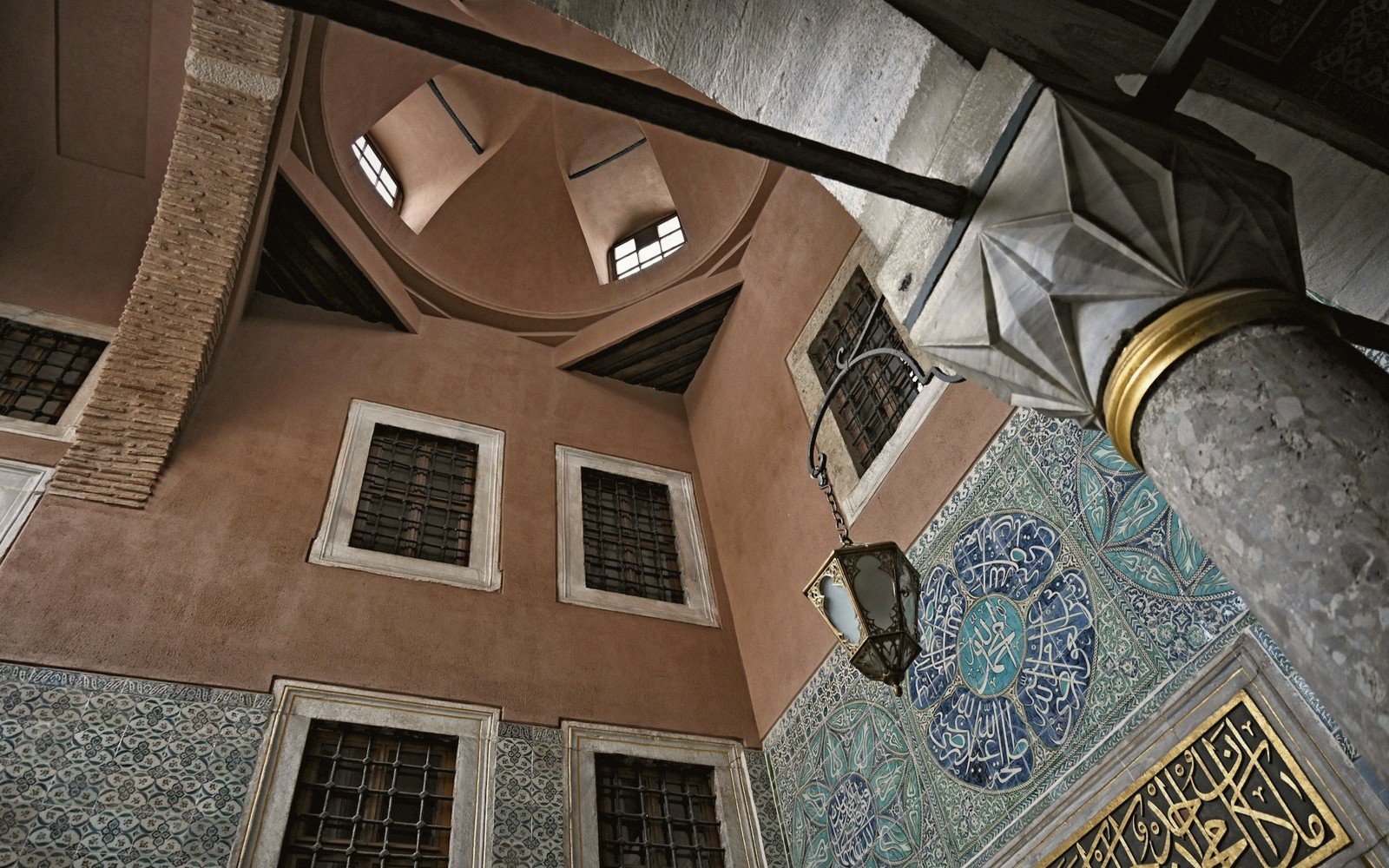
The workshops of İznik produced star-and-cross panels in quantity for the great building campaigns of the sixteenth century — Topkapı's tiled chambers, the Rüstem Paşa mosque in Istanbul, Selimiye in Edirne. The palette shifted across that period: early work tends toward a cooler, more restrained blue-and-white; later panels bring in the famous bole red, a colour that sits slightly raised above the glaze surface and catches raking light in a way that photographs have never quite managed to capture. But the geometry underneath did not change. The star-and-cross is older than any of those buildings, older than the Ottoman period itself; it appears in cut-plaster and carved stone across the medieval Islamic world. The tilemakers inherited a system already proven by centuries of masons working at much larger scale.
One further thing is worth noting in a tiled room: the pattern does not appear to recede. A chequerboard grid pulls the eye toward a vanishing point; a star-and-cross field resists this. The eight-pointed star is rotationally symmetrical enough that no single direction dominates. Your eye moves, finds another star, moves again — and the surface holds you at the surface. That is not an accident of decoration. It is the geometry doing exactly what it was designed to do: to fill a wall with movement while insisting, quietly, that the wall remains a wall.
Without that frame, the truncated star-points at the panel edge would read as damage.