An independent guide to the culture, places and craft of Turkey
Ancient Anatolia
What Göbekli Tepe Changed About the Story
A hilltop in southeastern Turkey, some carved stones, and the collapse of an idea that had stood for decades.
By the ReaderAncient Anatolia6 min readNeolithic
01The Story Before the Hill
For most of the twentieth century, prehistorians worked with a sequence that seemed almost self-evident. Hunter-gatherers were mobile, opportunistic and, by the nature of their condition, architecturally modest. Farming changed that. Surplus grain meant stored wealth; stored wealth meant settlement; settlement, in time, meant organisation, labour coordination and, eventually, the first large structures — temples, granaries, enclosures. Religion, ritual and monumental building were understood as downstream effects of agriculture, the cultural superstructure that complex societies erected once the food problem was solved. The model had a name — the Neolithic Revolution — and it had the satisfying logic of a clear before and after.
The site that dismantled this sequence sits on a limestone ridge in the Harran Plain of southeastern Turkey, about fifteen kilometres northeast of the city of Şanlıurfa. The ridge is called Göbekli Tepe — roughly, Potbelly Hill in Turkish — and it has been eroding the sequence so steadily since serious excavation began in the 1990s that prehistorians have had to rethink not just the order of events but the assumptions buried underneath it.
02What the Excavations Found
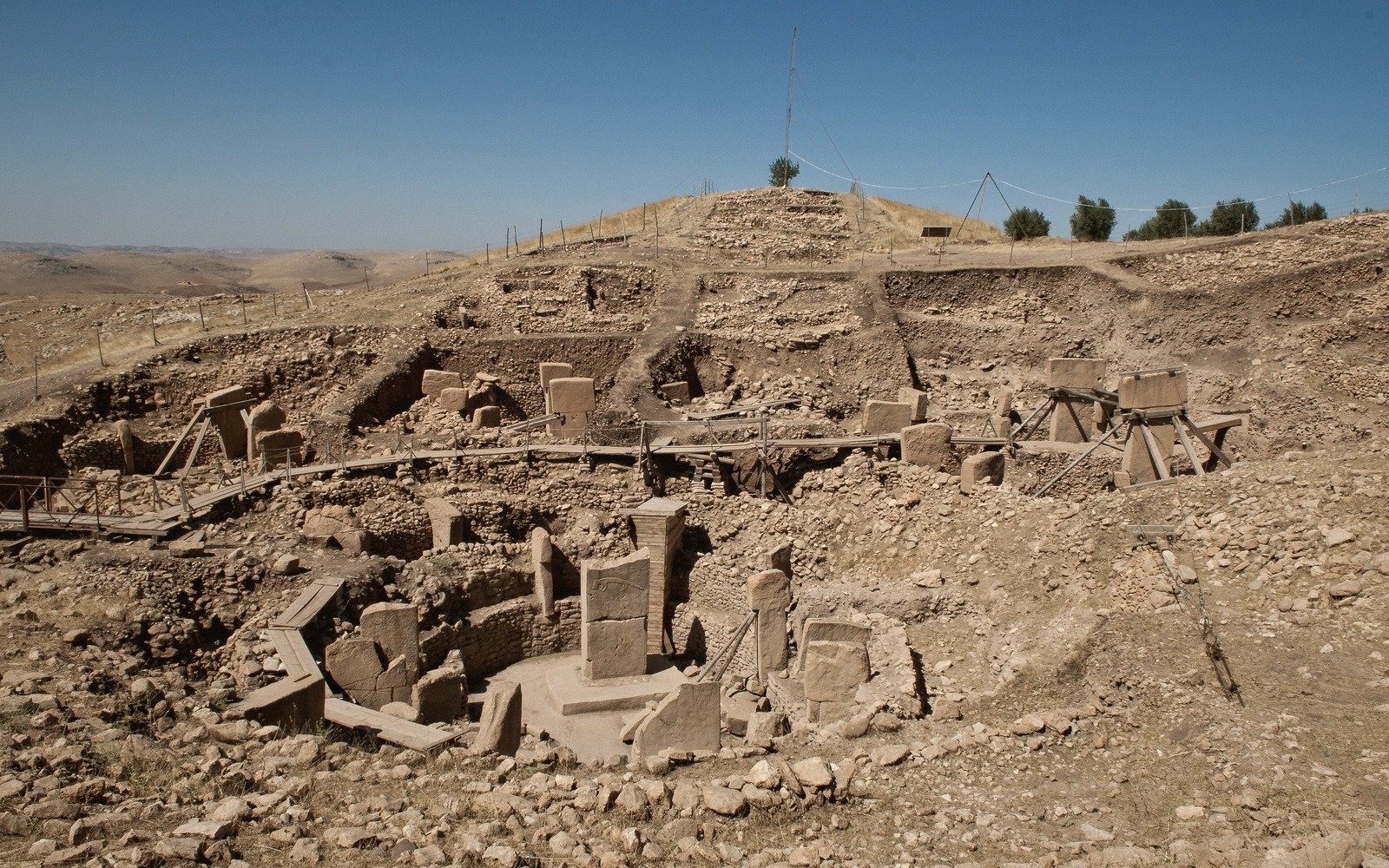
The German archaeologist Klaus Schmidt began systematic work at Göbekli Tepe in 1995, continuing until his death in 2014. What he and his team uncovered — and what the German Archaeological Institute and Turkish partners have continued to uncover since — is a series of enclosures cut into the bedrock of the hilltop, each roughly circular or oval in plan, each defined by two central T-shaped limestone pillars surrounded by a ring of smaller T-shaped pillars set into low stone benches. The pillars are not rough standing stones. They are carved, often in low relief but sometimes in high, with a bestiary of animals: foxes, vultures, scorpions, snakes, wild boar, lions, cranes. Some carry carved arms, belts and hands near the base, suggesting that the pillars represent something closer to stylised human figures than to purely abstract forms. The largest pillars are roughly five and a half metres tall and weigh several tonnes.
The radiocarbon dates that came back from the site were, and remain, startling. The oldest layers predate the beginning of agriculture in the region. The enclosures at Göbekli Tepe — sophisticated, labour-intensive, decoratively complex — were built by people who, as far as the current evidence tells us, were still hunting aurochs, gazelle and wild ass, and gathering wild cereals rather than cultivating them. The site is generally placed around ten to twelve thousand years ago, making it contemporary with the very earliest phases of the Neolithic transition rather than consequent upon it.
The scale of the undertaking is worth dwelling on. The stone was quarried from the limestone plateau nearby — unfinished pillars, still attached to the bedrock, can be seen in the quarry — then shaped, transported and raised. Estimates of the workforce required vary, but there is broad agreement that no small residential band could have done this alone. People were coming together, in numbers, to build something, and they were doing so before the organisational infrastructure that agriculture supposedly made possible.
They are deliberate, varied and, in some cases, compositionally ambitious.
By the numbers
~15 kmdistance from Göbekli
Up to ~5.5 mheight
Several tonnesestimated weight
10,000–12,000 years agoapproximate age
2018year of UNESCO
1995year Klaus Schmidt
03The Reversal
What Göbekli Tepe proposed — and what its dating has made very difficult to dismiss — is a direct inversion of the received sequence. The monumental came first, or at least came alongside, rather than after, the agricultural. This matters because it pulls at the logic that had underpinned not just prehistoric studies but much broader thinking about how complexity arises.
One influential interpretation, associated with Schmidt himself, holds that the ritual and symbolic demands of a site like Göbekli Tepe may actually have driven sedentism and agriculture, rather than resulting from them. If large numbers of people were congregating regularly at a sacred hilltop — for whatever ceremonies the enclosures hosted — then someone had to feed them. The pressure to feed a periodic assembly of hundreds of people, the argument goes, could itself have been a spur to the controlled cultivation of wild cereals. Göbekli Tepe sits in a region that is genetically central to the domestication of einkorn wheat; that proximity is not universally taken as proof of the causal connection, but it is not easily dismissed either.
This remains contested. Other researchers caution against making Göbekli Tepe carry too much interpretive weight — pointing out that the site is still only partially excavated, that the picture will change, and that single sites rarely overturn entire frameworks on their own. Çatalhöyük, a few millennia later and far to the west in central Anatolia, offers its own challenge to easy sequences: a settled, densely built community whose layout defied the conventions we associate with towns. Each site, in its own way, suggests that the prehistoric past was more varied, more inventive, than the standard models allowed.
What is not seriously contested is that the people who built Göbekli Tepe possessed sophisticated symbolic thought — a capacity for abstract representation, for encoding meaning in carved images, for coordinating collective action around a shared purpose — long before any of the material markers we had associated with 'civilisation' appeared. The carvings are not primitive scratchings. They are deliberate, varied and, in some cases, compositionally ambitious.
04What Remains Open
The enclosures at Göbekli Tepe were not used indefinitely. At some point — and the timing and reasons are still studied — they were deliberately backfilled with rubble, sediment and debris. This filling preserved them extraordinarily well but also raises questions that have not been answered. Was this an act of ritual closure, a controlled ending of a sacred space? Was it more pragmatic? The site does not offer an obvious answer, and that opacity is itself instructive: Göbekli Tepe is a site that keeps generating questions faster than it resolves them.
The excavation is ongoing. Only a fraction of the site has been opened; geomagnetic survey has identified many more enclosures beneath the surface, and the full extent of what is there is not yet known. The UNESCO World Heritage listing, which came in 2018, brought international attention and scrutiny — and the kind of infrastructure that protects the exposed stonework from the elements — without resolving the deeper interpretive debates. Those will take decades more.
For visitors approaching from Şanlıurfa, the site itself can be quietly disorienting. The hilltop is open and dry, the plain stretching south toward the Syrian border. The covered excavation areas shelter pillars that still carry their carved reliefs, the fox or the vulture still legible after ten millennia. There is nothing here that reads as a temple in any shape you might recognise from Ephesus or from the mosque-lined skyline of a Turkish city. The forms are entirely their own, from a cognitive world we can map only partially.
05The Larger Shift
What Göbekli Tepe ultimately changed is not just a timeline. It changed the underlying assumption that complexity is always a consequence, never a cause — that ritual, symbol and collective building are rewards that settled, agricultural societies eventually grant themselves. The hill in the Harran Plain makes that assumption very hard to hold. The people who shaped those pillars and raised them into position were doing something that required sustained effort, shared intention and a symbolic vocabulary. They did it before farming. They may have done it before anything we would call a village.
The honest response to Göbekli Tepe is not a new grand theory but a more open-handed relationship with what we thought we knew. Prehistoric humans were capable of more, earlier, than the models predicted — and the models should change to fit the evidence, not the other way around. That is a familiar instruction in any field of inquiry. It is more arresting when the evidence is a hilltop full of carved stones, sitting in plain sight for ten thousand years, waiting to be asked the right questions.
How it went, in order
A chronology, as the sources give it.
c. 10,000–12,000 years agooldest enclosures at Göbekli Tepe constructed
c. 9,000 years ago (approx.)deliberate backfilling of enclosures begins
1995Klaus Schmidt begins systematic excavation with German Archaeological Institute
2014Klaus Schmidt dies; excavations continue under Turkish and German teams
2018UNESCO World Heritage status awarded
map-slot
Locator for Göbekli Tepe — real geometry, true coordinates.
Göbekli Tepe on the map of pinned sites. Drawn from the supplied Natural Earth geometry at true coordinates — nothing here is sketched. Every guide carries a pin and a layer, so a place can be found by where it is or by when it is.
Named in this guide
Klaus Schmidt
German archaeologist who led excavations at Göbekli Tepe from 1995 until his death in 2014.
Şanlıurfa
Nearest city to Göbekli Tepe, southeastern Turkey; also spelled Urfa.
German Archaeological Institute
Principal international partner in Göbekli Tepe excavations.
Harran Plain
Broad agricultural plain in southeastern Turkey on which Göbekli Tepe sits.
Göbekli Tepe
Pre-pottery Neolithic site on a limestone ridge, southeastern Turkey; dates to c. 10,000–12,000 years ago.
Words used above
T-shaped pillar
monolithic limestone column with a widened horizontal top, characteristic of Göbekli Tepe enclosures
Neolithic Revolution
the transition from hunter-gatherer life to settled farming, conventionally understood as beginning around 10,000 BCE
Einkorn wheat
an early domesticated wheat variety; wild progenitor found in the region around Göbekli Tepe
Geomagnetic survey
non-invasive technique using magnetic readings to map buried structures without excavation
Sedentism
the practice of living in permanent or semi-permanent settlements rather than moving seasonally