01The Structure That Holds Everything Together
Pick up any Anatolian carpet and you are holding a composed argument. The weaver did not simply fill a rectangle with pattern; she — and in village tradition it was almost always she — built a hierarchy of frames, each one performing a distinct role. Miss the structure, and you see only decoration. Read it correctly, and the whole thing snaps into focus.
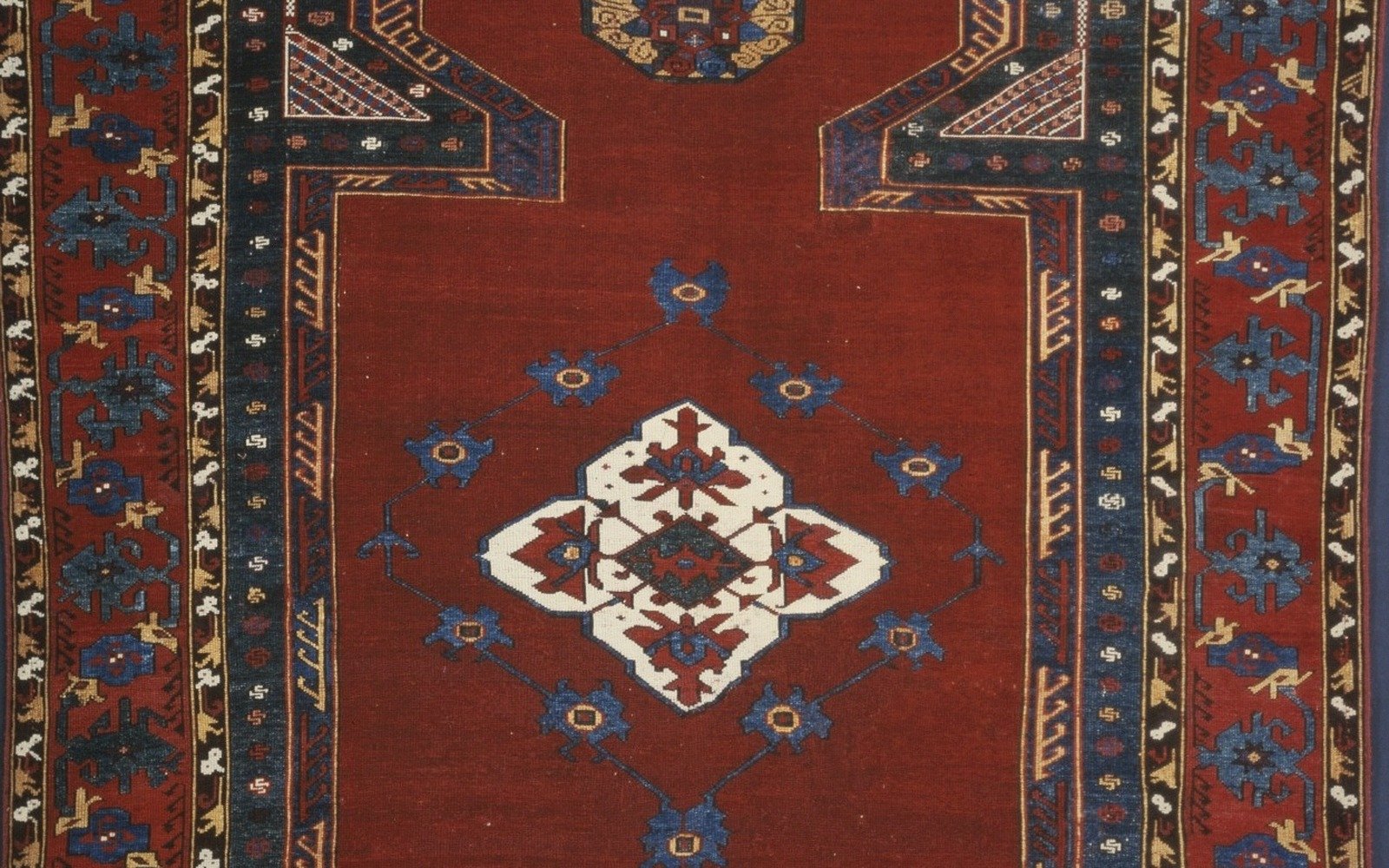
The outermost edge of a carpet's design is the border, a band that runs continuously around the perimeter, sealing the composition inside like the frame of a painting. But the border is not one band; it is typically three. The wide central border carries the dominant secondary pattern — a vine scroll, a Kufic-derived interlace, a chain of cloud bands. On either side of it run guard stripes, narrow bands of simpler repeat — small rosettes, a running S-form, a diagonal meander — whose job is to negotiate the visual jump between the main border and what lies beyond. The outer guard meets the plain flat weave at the edge; the inner guard delivers the eye, without collision, into the field. Both are servants. Neither announces itself. When they are done well, you do not notice them at all.
Inside the border system lies the field — the large central expanse that is the carpet's primary statement. This is where the reading gets interesting, because the field can be handled in two completely different ways, and the choice defines an entire family of rugs. In one approach, the field is divided by a lattice: diamonds, hexagons, offset squares, each compartment containing a single flower, leaf, rosette or animal. The repeat tiles across the surface with the same logic as a tile panel on a wall, implying that the pattern continues beyond all four edges, that the carpet is a window onto an infinite repeat. In the other approach, the field is organised around a medallion — a central form, usually eight-pointed, lobed, star-shaped or round, that anchors the composition with a single dominant motif. Quarter-medallions often bloom from the four corners, completing the form as though it were sliced through by the border. Both systems have long histories in Anatolia, and both can appear on rugs from the same region across the same century; the choice is compositional, not merely regional.
02What the Field Is Actually Saying
The medallion layout descends, in its most elaborate court form, from the tradition of manuscript illumination: the same lobed medallion that crowded the opening pages of an Ottoman Qur'an could be scaled up, rotated and woven in wool or silk. The great court carpets produced in Bursa and later in Istanbul workshops during the sixteenth and seventeenth centuries pushed this logic to its extreme — a single medallion, sometimes flanked by pendant tear-drops called Hatayi forms, floats in a field of curving split-leaf arabesques, the whole composition so precisely centralised that it reads almost as architecture. These are not the rugs most visitors encounter first.
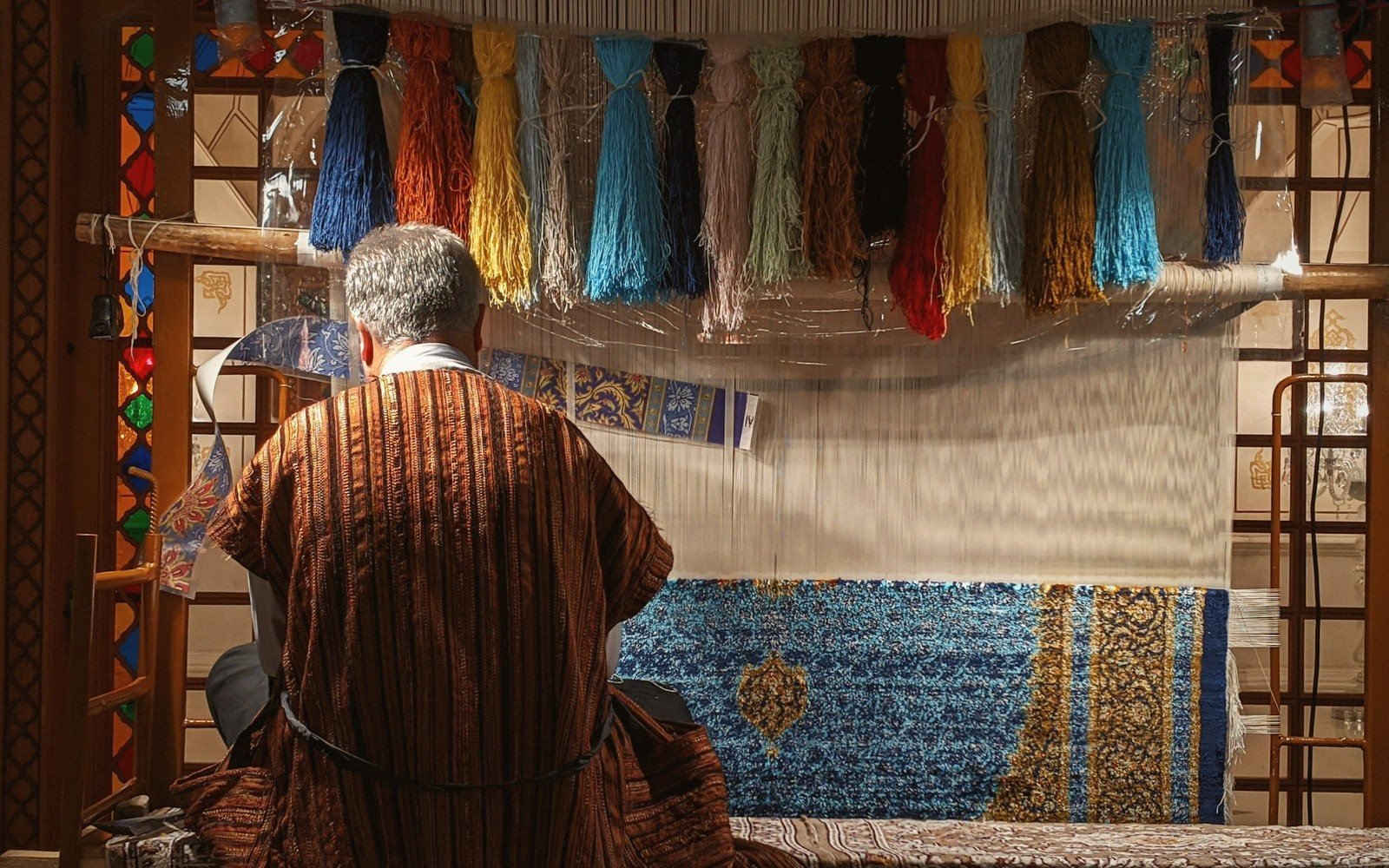
Village and nomadic rugs from central and eastern Anatolia — the pieces made on horizontal ground looms or simple vertical frames in Konya's hinterland, in Yörük encampments across the Taurus, in Kurdish communities along the upper Euphrates — tend instead to the repeat-field system, or to a loose medallion floating among scattered subsidiary motifs that break any rigid axial symmetry. Here the field reads as a densely populated landscape: a central diamond or star sits above and below smaller reciprocal forms, the ground between them alive with angular flower-heads, stylised birds, hooked combs and protective eye-symbols called nazar boncuğu in common speech, though in weaving they more often appear as concentric diamond-lozenges. Nothing is quite centred; the repeat is slightly irregular because the weaver kept no painted cartoon, only a mental count and a practised hand. That irregularity is not a flaw. It is evidence of a live intelligence at the loom.
The kilim deserves a separate note, because its structure alters the grammar entirely. A kilim is a flat-weave — no pile, weft threads carried back and forth and packed tight against the warp to build the pattern. Without pile, the visual language becomes more geometric still: curves are impossible or nearly so, and the forms that emerge are wedges, hooks, stepped triangles and strong diagonal lines. Colour meets colour at a vertical slit where two weft shuttles turn back around adjacent warp threads, and that slit becomes, in strong light, a structural drawing. Kilims from Konya and the Sivas region are among the most celebrated — large, spare compositions where a few bold forms in madder red, indigo and undyed cream carry the whole weight of the design. They do not try to be pile rugs, and their rigour is their beauty.
Weld and pomegranate rind gave yellows; the combination of indigo and weld gave the greens.