01What You Are Looking At
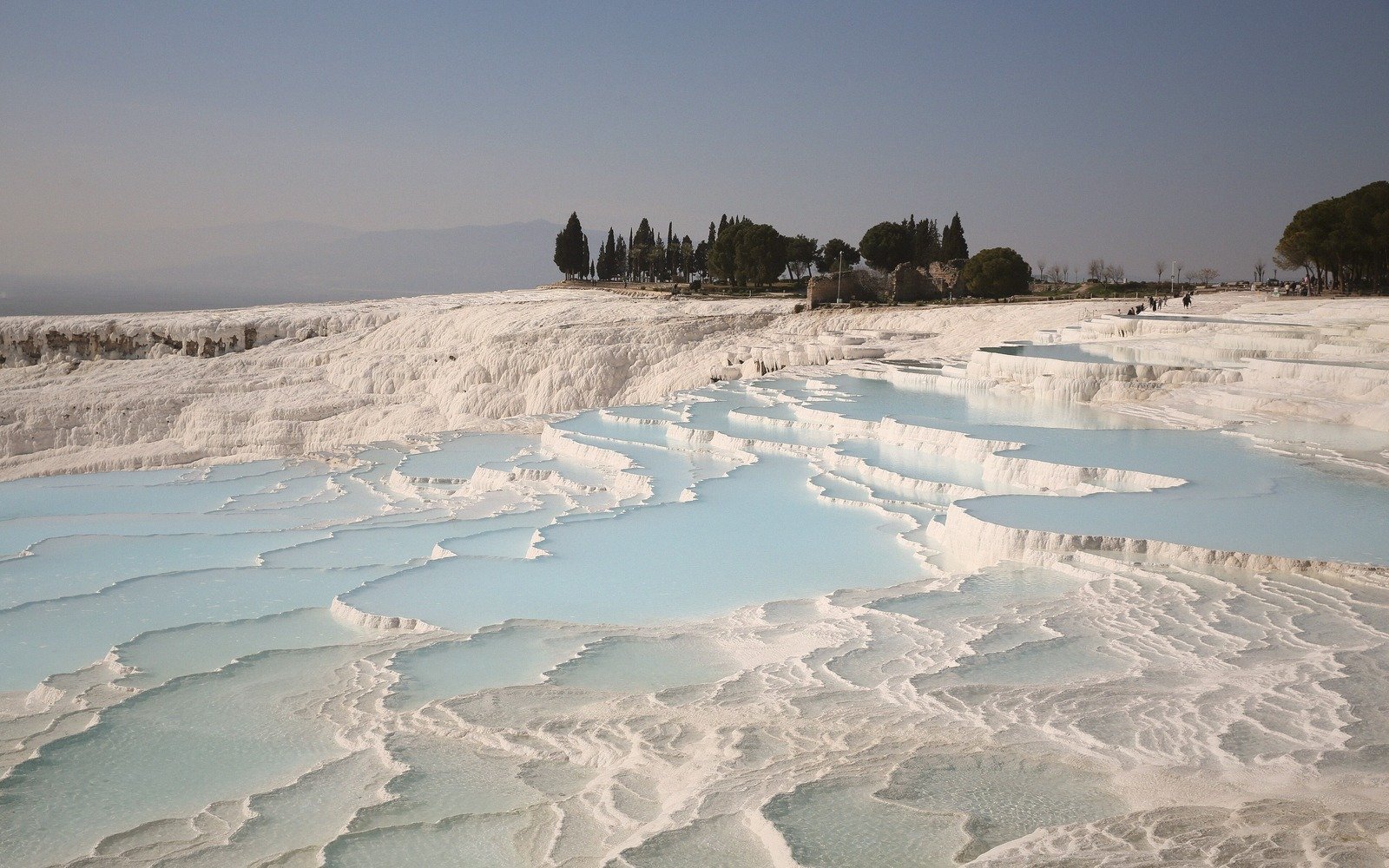
Seen from the valley floor, Pamukkale rises like a cliffside covered in snow that never melts. The white is real, the geometry is real, but "cliff" and "snow" are both wrong. What you are looking at is travertine — calcium carbonate deposited layer by layer by mineral-rich thermal water spilling down a hillside — and the process that built it is still happening now.
The water originates underground, where it passes through limestone bedrock under heat and pressure. This dissolves calcium carbonate into solution. When the water emerges at the surface, the pressure drops, carbon dioxide escapes into the air, and the calcium carbonate can no longer stay dissolved. It precipitates out as calcite crystals, coating whatever the water flows over — stone, sediment, the rim of a pool, a fallen leaf, a twig — in a crust of white mineral. Over time, the crusts thicken. Pool rims build up into curved lips called rimstone dams, which raise the water level, which deepens the pool, which spills more water over the edge, which deposits more calcite downslope. The terraces are self-reinforcing structures, shaped by the same physics that form stalactites in caves, except here they are open to the sky and fed by hot spring water rather than seeping rainwater.
The hillside at Pamukkale is roughly two hundred metres high and the active flow extends across a significant width of it. The thermal springs at the top discharge water that sits around thirty-five degrees Celsius — warm enough to swim in, cool enough not to scald. That temperature is part of why the site feels extraordinary to stand in: the warmth underfoot, the mineral smell, the thin warm film of water moving across white calcite in full afternoon light.
02The White Keeps Moving
Travertine at Pamukkale is not a fixed landscape in the way a granite cliff is fixed. The white surface that looks ancient can be geologically recent — calcite deposits build up quickly by geological standards, and the active zones shift as the water finds new paths down the hill. Where the water flows, the calcite is bright, wet and growing. Where the water stops — because a dam diverts it, or a duct redirects it, or a terrace becomes full — the calcite begins to dry, turns grey, and eventually looks less like snow and more like dusty limestone. The difference between "active" and "inactive" travertine is simply whether the water is there.
This matters for understanding what happened at Pamukkale across several decades of heavy visitor pressure. Pools were drained or diverted. Hotels were built directly on the travertine. Tourists walked barefoot and otherwise across surfaces that had taken centuries to form. Sections bleached and dulled. The intervention that followed — demolition of the hotels built on the terraces, closure of some areas, controlled routing of the spring water across specific sections — was an attempt to restart the calcite deposition in areas that had dried out. Water was re-routed, and the active zones were allowed to recover. The white has returned to sections that had greyed. This is not restoration in the way you restore a painting; it is more like redirecting a river and waiting for it to do what rivers do.
Visitors now walk certain prescribed paths, largely barefoot — shoes are removed to protect the calcite — and the areas where water is actively flowing are visibly brighter than the sections left to dry between seasonal diversions. The management is, essentially, a form of agricultural rotation applied to mineral deposition.
Travertine at Pamukkale is not a fixed landscape in the way a granite cliff is fixed.